

The Story of More
Hope Jahren
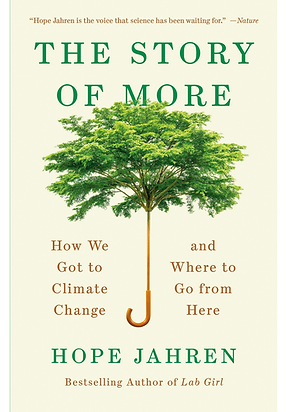
The solution Hope proposes to combat climate change, or global warming, is reflected in the title of her book. In the last chapter she says, after listing current suggestions to reduce carbon dioxide and mitigate global warming: “None of the solutions above, however, address the root of the problem or have the potential to alter our future the way a serious shift toward energy conservation could….”As a solution, energy conservation by its very definition requires the least effort of any approach. It is a very strong lever which we could pull ourselves back into alignment with a future that our grandchildren might survive.”
I recall back in the late 1970s, a book called “More with Less”. I have a cookbook entitled, “More with Less.” I have personally thought that doing with less stuff, building an energy efficient house, and joining a dedicated group of people concerned about climate change was doing my part to address the climate crisis we are in. But, living in the United States, and adopting that lifestyle in most aspects of my life doesn’t come close to the solutions Jahren is suggesting. After all, I just got back from flying to Europe on a commercial airline. Jahren points out in her book that, while automobiles now average 30 miles to a gallon, jet airliners average 400 feet per gallon. Busted.
Jahren divides her book into four parts: part one, “Life.” It explains who, how, and where we are on this planet. This section traces the history of life on earth and ends with describing the current global population and the problems of people moving into cities and away from places that produce food and care for the natural world
Part two is “Food.” This explores grains, meat, fish, and our obsession with sugar. She has a tongue in cheek comment on meat: “Sooner or late we will have to reconsider the fact that every year, we actively waste 90 percent of the grain we feed to animals, in exchange for a little meat and a lot of manure.” In regards to fish we eat, Norway’s fishing industry far surpasses any other country, and currently half the salmon caught are in cages in the sea, part of an aquaculture shift in fishing. And Jahren lists many problems with that development. The final chapter in this section is devoted to waste, food and human waste. Her descriptions of human waste are humorous as well as compelling. She points out the original name of St. Paul was Pig’s Eye.
Part three is “Energy.” A couple of quotes: “Americans are the world’s heaviest energy users, consuming a full 15 percent of the world’s energy production and almost 20 percent of the world’s electricity, despite making up only 4 percent of he world’s population.” “Curbing consumption will be the ultimate trial of the twenty-first century. Using less and sharing more is the biggest challenge our generation will ever face.” For instance, Hope doesn’t think renewables, solar, wind, water, will be a viable solution unless using less and sharing more electricity is part of the equation.
Part four is entitled, “Earth.” The air we breathe has been altered, more CO2. The weather has changed, warmer air, more violent storms, melting ice, rising waters (“About half of the global sea-level rise that has occurred during the last fifty years is due to water added to the ocean from melting glaciers. The other half of the sea-level rise is due to the warming of ocean sea water”), species loss.
Hope Jahren also fills the book with personal experiences, home-spun analogies, and humor.
For example, in talking about over eating of meat: “There are nine hogs for every person in Iowa…. The unromantic truth is that the vast majority of Iowans do not know even one of their twenty-two million oinking neighbors.”
To emphasize her call to change our habit of consuming more and more energy as the most problematic cause of climate change, she offers appendixes that address ways to curb our consumption “I. The action you take; 2. The difference you make; and 3. an environmental catechism, a listing of environmental changes since 1969. It is very eye-opening.
I will conclude with her summary comments: “I stress one thing above all else: Having hope requires courage. It matters not only what we do about global change but how we talk about it, both in the classroom and beyond….We must go forward and live within the world that we have made, while understanding that its current state arises from a relentless Story of More. We can make this easier by being kind to one another along the way.”
John Hanson

Rev. John Hanson
EcoFaith Network NE MN Team
Big Fork, MN
Northeastern Minnesota Synod