

HERE’S MUD IN YOUR EYE!
‘Here’s mud in your eye!’ was one of my dad’s favorite toasts. As a kid, I thought it was one of the many nonsensical, funny sayings he’d made up.
Turns out, other people do actually use this phrase - though no one really knows where it comes from. Some people reckon it stems from today’s Gospel reading: Jesus uses mud to heal, so ‘mud in your eye’ is a toast to good health.
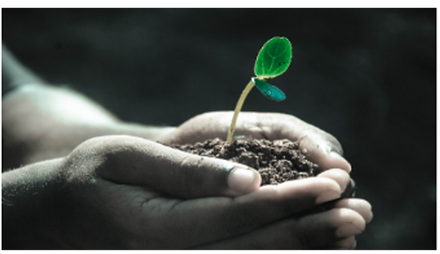
What if we could toast everyone, or maybe even put some mud in every eye (including our own), so that we could all, collectively, simultaneously, see clearly the glorious gift of creation - and life - God has entrusted to our care?
What if climate care became a norm, rather than a daily concern and global crisis?
Writing from the perspective of cultural organizing, Puerto Rico-born, Minneapolis-based protest artist and activist, Ricardo Levins Morales reminds us that ‘the soil is more important than the seeds’ and ‘it’s hard to get anything to grow if the soil is barren, toxic and won’t hold moisture.’ Reflecting on recent social justice losses and reversals, Levins Morales observes that climate-deniers and others have, ‘for forty years… devoted themselves largely to preparing the soil’ with toxic messages - including ‘stuff that sounds ridiculous, fighting for things that aren’t winnable yet, because they’re investing in the future and ten years later it won’t sound ridiculous and they’ll win’. He wonders, ‘What stories, what narratives, what beliefs - if they were widely disseminated in the soil of our communities - would make it easy to win? …What would make victories easy if everyone believed it? We’re the only ones who can plant the seed of the tree that one day we want to live under. We need to be preparing the soil in which that tree can grow.’[1]
Today’s readings are clearly an exhortation to open our eyes to new and seemingly impossible ideas. If we can see those impossible visions, we can share them; if we can share them, we can fertilize new soil; we can create the soil from which God’s desired future will root and grow.
We first need to see.
If what we see is not New Life for all of God’s beloved creation, including all of humanity - let’s check that the mud we’re wiping from our eyes contains Jesus’ spit and not someone else’s. Then, let’s look with renewed sight toward God’s preferred future, join Jesus and others in disseminating stories affirming and preparing for that future, and see if we can’t mix up some more mud and start spreading it around: things may get a little messy, but messy is far better than toxic.
And the spring / vernal equinox is the time.
According to the Farmer’s Almanac, ‘Vernal translates to “new” and “fresh,” and equinox [derives] from the Latin aequus (equal) and nox (night)... [O]ur hours of daylight… have been growing slightly longer each day since the winter solstice… The vernal equinox marks the turning point when daylight begins to win out over darkness.’[2]
It’s time to wake up, to open our eyes.
For our pagan, druidic, and many Indigenous siblings, the spring equinox is a celebration of the return of spring: a time for planting - both literally in gardens and for the soul’s well-being; it’s a time of ‘raw possibility’ (‘when Oestra’s egg of pure potential cracks open’), a time to set new intentions; it’s considered the New Year in some cultures. The spring equinox is also a time of ‘holy equality’, when dark and light/night and day are equal in length; it is a time of extraordinary balance, out of which many find courage, joy, and renewal - even as ‘the winds of change and uncertainty gust’ - because it is also a time of synergy with all creation and intimacy with ‘kindreds - human and non-human’.[3]
Without further appropriating Earth-centered spiritualities’ spring equinox celebrations[4], the Season of Lent - as so many of our Lenten texts reveal[5] - is the perfect time to take off the blinders, reconsider our perspective, and cast a new vision so we can ‘prepare the soil’ to receive seeds of hope and flourishing for creation and all humanity.
What might God be urging us to see or experience in this spring equinox? Where is God’s new life already springing into being as we move through these three days of balance and regeneration?
Today’s Gospel reading is a primer on the multiple and varied forms of human blindness - and the extraordinary lengths we’ll go to to remain blind, while perennially, generationally stigmatizing, shaming, and blaming those we see as blind. (See Ash Wednesday, Isaiah 58:9 for God’s opinion of, ‘the pointing of the finger’.)
Here’s an intergenerational ‘game’: set John 9 side-by-side with Dr. Tema Okun’s 15 Characteristics[6] of White Supremacy Culture[7] and see who can find the most connections the most quickly. The lines will be a tangle, as so many characteristics intersect, but in John’s narrative, every character exhibits or avoids one or a multitude of Okun’s 15 behaviors.
Okun’s apologetics for divorcing white supremacy culture sound much of like Jesus’ teaching in today’s Gospel: we have been hoodwinked, all of us, about what is really important’; ‘any attempt to be perfect is in fact a fool's errand (not that we are fools) because learning from our mistakes is how we grow and learn and lean into our glorious and flawed humanity. We can never be perfect when perfection is defined by others, particularly by institutions and cultures that do not care about or for us. We are, in fact, already perfect. We were born perfect. No striving necessary.’[8]
All of this is to say, supremacy culture lies at the heart of immense damage - to our individual selves and our individual human neighbors, to our neighborhoods and communities and society and culture; and to the planet as a whole. All this accepted blindness leads to generational traumas and catastrophic climactic distress.
The spring equinox is a cosmic moment of balance: an opportunity - embraced by our pagan, Indigenous, and druidic ancestors and contemporaries - to have our eyes opened.
And here’s Jesus with some mud in his hands.
And the waters of baptism lie always at the ready to wash the mud away.
For there is no room to assume that our vision is already clear - that smacks of defensiveness/denial intersecting with power hoarding and perfectionism with a heavy dose of a belief in ‘one’ right way mixed in for good measure.
It’s also exactly what the Pharisees assumed. And we all know what happens when we assume anything: Jesus turns us into a donkey…
#5 of Ricardo Levins Morales’ 8 pearls of wisdom for Tending the Soil is summarized above. Pearl #2 regards Moon Spaces, Sun Spaces & Community Power. Moon Spaces are where power is ‘reflected’, i.e., negotiating tables, court rooms, legislatures: ‘where contending forces try to settle their differences and come up with a decision’. Sun Spaces are where power is generated, i.e., ‘where the people are’: on the streets, in the movement. When ‘we don’t have a lot of leverage’, Levins Morales encourages us to create more alliances, develop broader networks, build up power in the Sun Spaces, so we have ‘more energy at our back’ entering the Moon Space of negotiations.[9]
What if we could get mud into everyone’s eyes, all at the same time? Could we all begin to see the way God sees? Could we all recognize the extraordinary abundance with which God provides us every day? Might narratives of abundance, healing, and joyful collegiality make for more fertile soil, where the seeds of renewal, reparations, restoration, i.e., New Life, might take root and grow?
The Spring Equinox seems a good time to assess - in whatever justice efforts we may endeavor - how to disseminate the Christian (but not unique) narrative of resurrection to broader and broader recipients. Where might we ‘generate more power’? What new alliances might we forge? With what other organizations or individuals might we partner to ‘give us more energy at our back’ so we enter Moon Spaces with a full tank?
In this three-day Equinox Season (that isn’t a coincidence) when the sun passes Earth’s celestial equator, moving northward to bring spring to the Northern Hemisphere and fall to the Southern, we see all sorts of promise (up here in the Northwoods it may take a little longer, but we’ll appreciate it all the more!): birds follow the sun and return North, buds and shoots begin to appear, the snow is melting as the earth and air are warming. Our bleary, snow-glare eyes are newly opened and dazzled by the splendor of New Life. Take your pick of metaphors: birds nesting and dropping eggs, butterflies returning, bunnies, squirrels, chippies and bears coming out of hibernation: the North is waking.
Now is the time to smear some mud on our eyes and let the spring rains wash it away.
Resurrection must be just around the corner - if we can open our eyes to see it.
Here’s mud in your eye!
[1] Levins Morales, Ricardo. Tending the Soil: Lessons for Organizing; pgs. 12-14. Download your free copy of the zine here: https://www.rlmartstudio.com/product/tending-the-soil-lessons-for-organizing-zine-free-pdfs/.
[2] https://www.farmersalmanac.com/spring-equinox-first-day-spring (accessed 02.20.23)
[3] We’Moon; Spring Equinox Rituals and Traditions (https://wemoon.ws/blogs/pagan-holiday-traditions/spring-equinox)
[4] See Baring, Anne, & Jules Cashford. The Myth of the Goddess: Evolution of an Image; London, Arkana: 1991; 566.
[5] Wanting to see ‘like God’ but instead descending into dualism (Gen. 3:5); lifting our eyes to the hills for help (Psalm 121); seeing God’s reign in anew (John 3/Matthew 17; Exodus 17:6) - or not (Psalm 95:9); being fully seen and inviting others to see (John 4); learning to see as God sees (1 Sam. 16:7); being led through shadow and illumination (Psalm 23; Ephesians 5); healing blindness (John 9); prophetic vision (Ezekiel 37); seeing new life (John 11:34ff).
[6] https://www.whitesupremacyculture.info/characteristics.html
[7] https://www.whitesupremacyculture.info/
[8] Ibid.
[9] Levins Morales, Ricardo. Tending the Soil, pgs. 4 & 5.

Rev. Emily Meyer
The Ministry Lab
Minneapolis, MN
Ordained in the ELCA, Rev. Emily Meyer has served as a choreographer; parish pastor; dance instructor; multi-congregational confirmation leader; costume designer; mindfulness and contemplative practices facilitator; music and worship writer; liturgical dance coordinator; retreat, summit, webinar, and workshop planner, facilitator, and presenter, and now puts all of that together as executive director of The Ministry Lab. She has written for Green Blades Rising Preachers Roundtable, Sundays and Seasons, 2024, and Currents in Theology and Mission - Preaching Helps. She serves on the ELCA’s Truth & Healing Initiative, chairs the EcoFaith Summit of the Upper Midwest Organizing Team, and served as Liturgical Arts Choreographer and Coordinator for the Lutheran World Federation's 2023 Global Assembly in Krakow, Poland.