

June 1, 2025
Pollinator Garden & Solar Pergola

Interview with Kim and Trent Wickman by John Sippola
Kim was inspired to design a pollinator garden after Trent told her about First Lutheran's. Then Trent, who had always wanted a solar array, found one that met with Kim's design sensibilities, and here's the result!
John: What events, experiences, and people influenced your interest in commercial design?
Kim: My Mom, Carol, loved beautiful things. She was a commercial artist and loved gardening. She had a vegetable garden and grew flowers. She knew how to make something beautiful out of nothing.
J: Trent, how about you, what and who influenced you?
Trent: I had a whole slew of great teachers. I grew up watching Mutual of Omaha‘s Wild Kingdom, a program that often featured endangered species, and I realized I wanted to protect them. My English teacher, Kathy Doyle, was aware of my interest in protecting nature and gave me books to read; Aldo Leopold’s The Sand County Almanac was one of them. Early on, when I was a boy, I wrote that I wanted to be the head of the Environmental Protection Agency in the books I read!
J: What are some of the books you’d recommend?
T: Oh, that’s tough! Braiding Sweetgrass by Robin Kimmerer, and Don’t be Such a Scientist by Randy Olson.
J: What’s that about?
T: Olson challenges scientists to be activists, making their voices heard in the public square instead of just publishing in scientific journals.
K: The old large maple tree we tapped for syrup aged, so we had to cut it down to prevent it from falling on the house. T: I told the tree removal guys to cut it into lengths and leave it for me. I got a chainsaw, a guide rail, and cut slabs. (Later in the interview, Trent and Kim showed me the tabletop in their living room.) T: Look at the base – Kim designed that!
During the interview, Kim and Trent engaged in a thoughtful exchange, avoiding interruptions and speaking at a measured pace, smiling as they responded in mutually respectful ways that built upon each other’s thoughts. I looked closely; the tabletop and base were beautiful – a testament to her artistry and their collaboration.
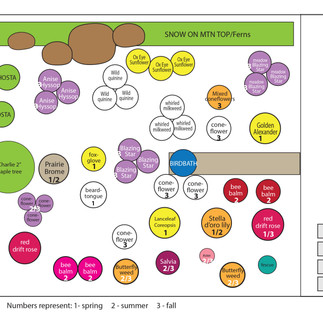
K: After the maple tree fell, I tried to rescue the ferns, but it was clear they weren’t thriving in all that sunlight, so I was uncertain about what to do. Trent was on the CC team and mentioned the church’s pollinator garden. I began researching northern Minnesota pollinators and found some great ideas on various websites. I love garage plant sales, usually held by elderly ladies, where I picked up some nice perennial pollinators. I created a garden plan and made circular cutouts of each species, then started arranging them on a blank page the size of the garden: tall plants in the back, shorter ones in the front; early bloomers here, later bloomers there; this color here, that color there. While placing them, I also considered when they bloom – in the spring, summer, or fall. I didn’t need much soil preparation. I got some native plants and purchased others from Menards. I later discovered at last year's Summit that some store-bought plants might not be recommended. Oh, and I acquired some butterfly weed. The day after I planted it, we immediately had monarchs. I can’t believe how they found it! I added a bird bath because I heard that pollinators drink from them, but I’m not sure about that, so don’t print it.
After the interview, I googled, and Kim was correct. Bees and butterflies do drink from bird baths. AI also provided this helpful tip: if you are working with a deck or balcony, choose a sunny spot near your plant pots and offer a shallow source of water. This could be a bird bath or a bowl with stones for bees and wasps to perch safely without slipping.
K: I also learned that different-colored bird baths attract different species. T: Every morning, I see K looking at her garden and considering how to improve it. K: Trent is doing the same thing – looking at his solar pergola.
My grandfather always saved everything. He removed nails and kept them in coffee tins. I wanted to save the lumber from the tree. I’ve always dreamed of installing solar panels to contribute more to protecting the environment! Kim shot down the idea of putting panels in the front yard. I considered the space above the pollinator garden, but she didn’t like the rack system – thought it was too ugly. Then we discovered a rail system, and K gave it the thumbs up. I spent 3-4 months planning, acting as the general contractor, securing all the permits, addressing the setbacks, and getting approval from the city engineer, among other tasks. All the details are on the large poster I made for Earth Day. I’ll make it available for Pollinator Sunday on June 22.
T: The scariest day was placing the rafters on the support beam. I didn’t have anyone else present when I measured and cut the notches for the rafters on the custom-made cross beam. K: Neither of us slept well the night before. My stomach was churning. T: We used a chain hoist to lift the beams. K: I was yelling instructions as they hoisted to ensure the rafters lined up with the notches. T: The first beam was six inches off - our hearts sank. Then I noticed that one of the guideposts was leaning. I straightened it out, and the beam fell into place! We breathed a huge sigh of relief.
We talked about Trent's need to find another job due to the current cutbacks in DNR funding, and his excitement about his new teaching position at his alma mater, Michigan Tech.
K: When we move to Houghton, Michigan, I’ll create another pollinator garden – a Michigan version this time!



EcoFaith
Northeastern Minnesota Synod
Living out God’s call to be stewards of the earth for the sake of the whole creation.